Thousands of Referrals Upon Request • Aftercare provided by Registered Nurses when needed • Dual Board Certified Facial Plastic Surgeon • Advanced Fellowship-Trained in Facial Plastic & Reconstructive Surgery • Over 21 Years at Pacific Hills Surgery Center • Exclusive Allergan Provider • 100% Authentic Products • Most Advanced Laser Hair Removal Technology •
What to Expect: A Realistic Facial Surgery Recovery Timeline
Recovery is often the biggest question, not the surgery itself. If you are considering a facelift, neck lift, brow lift, or eyelid lift, you may already understand the procedure but still wonder what the weeks afterward could look like.
This guide walks through facial surgery recovery in a cautious, educational way. Recovery varies by patient, procedure, health history, and individual healing, so the timing below is a general orientation rather than a personal medical plan.
Facial Surgery Recovery at a Glance
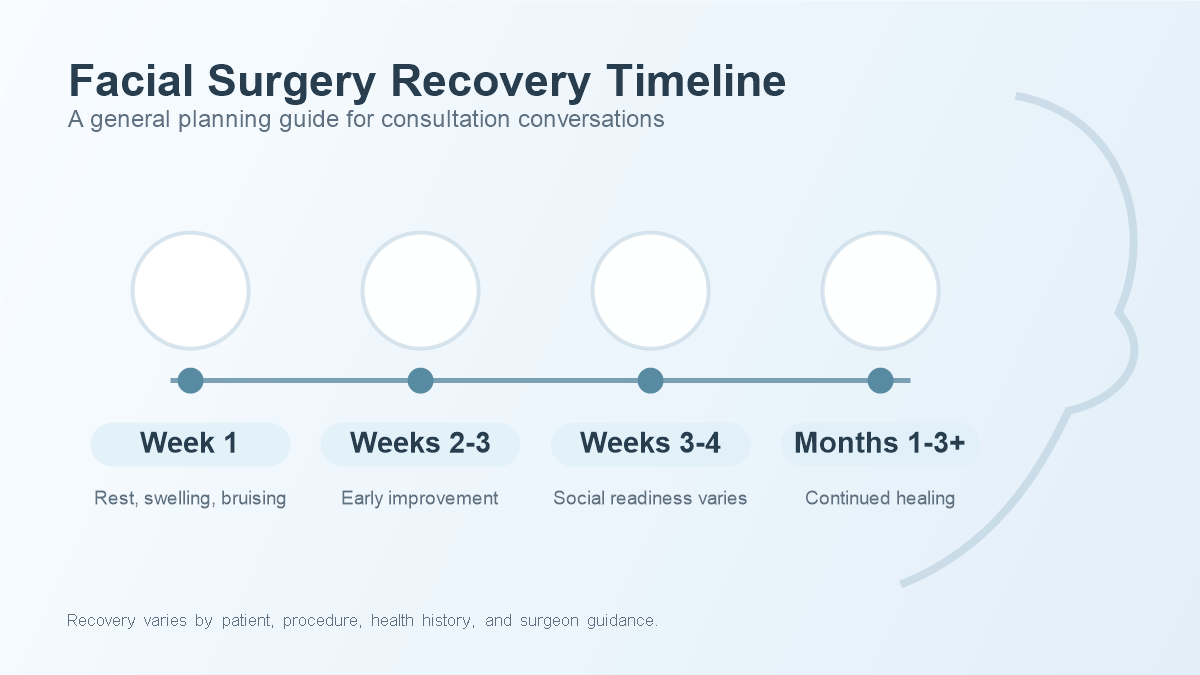
Recovery after facial surgery can unfold in broad phases:
Week 1: Rest, swelling, and bruising are often most visible; many patients choose to stay home.
Weeks 2-3: Swelling and bruising may begin to ease; some patients resume light, non-public work.
Weeks 3-4: Some patients feel more comfortable in social settings, depending on healing and procedure scope.
Months 1-3+: Healing continues gradually as residual swelling settles.
Every patient heals differently. Your surgeon will give you instructions based on your procedure, anatomy, and health history.
Why Recovery Feels Uncertain, and How to Prepare
Many people who hesitate before facial surgery are not only thinking about the operating room. They are thinking about the weeks after it: visible bruising, work calls, family obligations, and how long they may want to stay out of public view.
Those concerns are real and worth planning for. A personalized consultation is where that planning starts.
Dr. Ernest B. Robinson, M.D. is a dual board-certified facial plastic surgeon certified by the American Academy of Facial Plastic and Reconstructive Surgery and the American Board of Otolaryngology – Head and Neck Surgery. During consultation, he reviews goals, anatomy, candidacy, procedure options, and realistic recovery expectations.
Week 1: Rest, Swelling, and Bruising
The first week is often the most visible phase of recovery. Swelling and bruising can be noticeable, and many patients prefer to keep their calendar quiet while they rest.
Possible Week 1 experiences include:
Swelling that begins after surgery and may be more noticeable in the first several days.
Bruising that can appear around the treated areas and, depending on the procedure, sometimes extend into nearby areas.
Dressings, drains, or sutures that may be checked or removed during follow-up visits.
Pressure, tightness, or discomfort that should be discussed with the clinical team and managed according to instructions.
Limited activity while the body begins healing.
This is a practical time to arrange help at home, prepare meals, and avoid unnecessary commitments. Individual healing varies, so follow the instructions given for your specific procedure.
Weeks 2-3: Early Improvement and Light Activity
During weeks two and three, some patients notice that bruising starts to change color and swelling becomes less intense. Others need more time. The pace is individual.
Light, non-public work may be possible for some patients during this period, especially if they work from home. Public-facing meetings, travel, exercise, and social events should be planned around your surgeon’s guidance and your comfort level.
Common experiences can include:
Tightness or temporary numbness in treated areas.
Itching as incision sites heal.
Uneven swelling from one side to the other.
Lower energy while the body is still recovering.
Your surgeon’s team can advise when camouflage makeup, skin care, and normal routines are appropriate.
Weeks 3-4: Returning to Social Settings
By weeks three and four, some patients feel more comfortable being seen socially, while others prefer more time. This depends on the procedure, bruising, swelling, incision healing, and personal comfort.
Sun protection is important during this phase because healing skin can be more sensitive. Strenuous activity should wait until your surgeon clears it.
If your job is public-facing or physically demanding, discuss timing before surgery. Recovery planning is part of the consultation, not something to guess afterward.
Months 1-3 and Beyond: Continued Healing
Healing does not end when bruising is less visible. Subtle swelling, tightness, and sensation changes can continue to improve over weeks or months.
Because healing is gradual, it is not useful to compare your early recovery to another person’s photo or story. Before-and-after images, when used, should never be treated as a promise of a specific outcome.
Patience is part of recovery. Follow-up visits help your surgeon monitor healing and answer questions as they come up.
Combining procedures can change the overall recovery plan. A focused eyelid procedure may feel different from a combined facelift and neck lift. Your consultation should cover what is realistic for the exact plan being considered.
What About Non-Surgical Options?
For some patients, recovery time is one reason to ask about non-surgical choices. Robinson Facial Plastic Surgery offers non-surgical facial procedures such as dermal fillers and liquid facelift services.
Non-surgical options are different in scope and duration from surgery. Injectable results are temporary and maintained with repeat treatment. Candidacy depends on your anatomy, goals, and medical history.
Bruising After a Facelift
Bruising after a facelift is a common recovery concern. It can be visible in the early phase and gradually fade, but the timeline is different for each patient.
Factors such as skin type, age, medication history, procedure scope, and individual healing can all affect bruising. Your surgeon may provide specific pre- and post-operative instructions to help support recovery.
This article is not a clinical protocol. Follow your surgeon’s instructions rather than general internet guidance.
Planning Your Recovery
Recovery happens in the middle of real life: work, family, travel, and social commitments. Planning ahead can make the process easier.
Before consultation, consider:
How much time you can realistically keep clear.
Whether someone can help during the first few days.
Which work or family obligations cannot move.
Whether travel or out-of-town planning is needed.
Which questions you want answered before choosing a procedure.
Robinson Facial Plastic Surgery accommodates out-of-town patients and can discuss planning considerations during consultation.
Frequently Asked Questions About Facial Surgery Recovery
How long does it take to recover from a facelift?
Recovery varies by patient and by the exact procedure. Some patients plan for one to two quieter weeks at home, then gradually return to more public activities as swelling and bruising improve. Your surgeon will give you a more specific plan based on your health, anatomy, and procedure.
When does bruising after a facelift fade?
Bruising often changes over the first few weeks, but timing varies. Skin type, medication history, age, procedure scope, and individual healing all matter. Ask your surgeon when makeup or normal skin care is appropriate for your incision healing.
Can I work during facial surgery recovery?
It depends on your work. Desk-based or remote work may be easier to resume earlier than public-facing or physically demanding work. Bring your work calendar to consultation so your surgeon can help you plan.
Is recovery different for a facelift and a neck lift?
Yes. Each procedure affects different areas and may involve a different recovery pattern. When procedures are combined, the overall recovery plan may change. Your surgeon will explain what to expect for your specific plan.
Is there a non-surgical option with less downtime?
Some patients may be candidates for non-surgical options such as dermal fillers or a liquid facelift. These treatments are different from surgery in scope and duration, and injectable results are temporary. A consultation helps determine whether a surgical or non-surgical approach better fits your goals.
The Right Next Step
Every face is different. Every recovery is different. A personalized consultation with Dr. Robinson can cover goals, candidacy, procedure options, and what recovery may look like for your situation.
To request a consultation, call (949) 831-5900 or use the Book Now option on drface.com.
This content is educational and does not constitute medical advice. Use of this website does not create a physician/patient relationship between you and Robinson Facial Plastic Surgery. Results vary by patient.
Contains information related to marketing campaigns of the user. These are shared with Google AdWords / Google Ads when the Google Ads and Google Analytics accounts are linked together.
90 days
__utma
ID used to identify users and sessions
2 years after last activity
__utmt
Used to monitor number of Google Analytics server requests
10 minutes
__utmb
Used to distinguish new sessions and visits. This cookie is set when the GA.js javascript library is loaded and there is no existing __utmb cookie. The cookie is updated every time data is sent to the Google Analytics server.
30 minutes after last activity
__utmc
Used only with old Urchin versions of Google Analytics and not with GA.js. Was used to distinguish between new sessions and visits at the end of a session.
End of session (browser)
__utmz
Contains information about the traffic source or campaign that directed user to the website. The cookie is set when the GA.js javascript is loaded and updated when data is sent to the Google Anaytics server
6 months after last activity
__utmv
Contains custom information set by the web developer via the _setCustomVar method in Google Analytics. This cookie is updated every time new data is sent to the Google Analytics server.
2 years after last activity
__utmx
Used to determine whether a user is included in an A / B or Multivariate test.
18 months
_ga
ID used to identify users
2 years
_gali
Used by Google Analytics to determine which links on a page are being clicked
30 seconds
_ga_
ID used to identify users
2 years
_gid
ID used to identify users for 24 hours after last activity
24 hours
_gat
Used to monitor number of Google Analytics server requests when using Google Tag Manager

Leave a Reply